The data driving renewed interest in Northeast Ohio (Columbiana, Mahoning, Trumbull and Southern Ashtabula county) oil and gas development. Once abandoned, no longer.
Data releases from the Ohio Department of Natural Resources (ODNR) and county recorder offices continue to indicate renewed interest in an area once abandoned by the industry. Here I discuss some of data and considerations that drive the roughly $10-13 million/well investment from the likes of EOG, Antero and others to drill the modern 2.5-4 mile laterals becoming more common in the Utica Shale play.
Boom to Bust Up North… Until Recently
From 2012 and 2014, Trumbull County Ohio became the epicenter of the boom and the bust for extracting oil and gas from the Northern reaches of the Utica Shale play. BP famously signed and then discarding a pool of approximately 84,000 acres, suffering a $544 million Utica-related write-off. The rock under Trumbull County looked promising, and still does. I’m certain that BP had a lot of data and justification for the large cash layout to landowners. BP had high confidence that they would be successful. As it turned out, they were just a little ahead of the time when new completion methods are now proving successful in coaxing oil and gas out of the fracked subsurface in parts of Northeast Ohio once abandoned.
The Case for the North is Spelled W-E-H-R
The Norther Tier story is highlighted by one well. EOG, Wehr Spring Valley Farm MH ELS 1H, coming online July 2025, the well has produced 97,111 barrels in four quarters. That production is 75% of everything Mahoning has produced since 2020. Before it, the county was running about 5,000 Bbl a year from five legacy wells drilled in 2014–2015.
What makes it notable geologically: it’s a 6,758 ft lateral, less than half the length of the Knox wells in Columbiana, and it still delivered 40,489 Bbl in its first partial quarter. Quarter to quarter declines are typical, from 40k to 25k, 16k, and most recently, Q2 2026, 15k Bbl, a normal decline curve. On a per-1,000-ft basis this well is competitive with the Columbiana liquids window, which suggests EOG found something worth testing this far north.
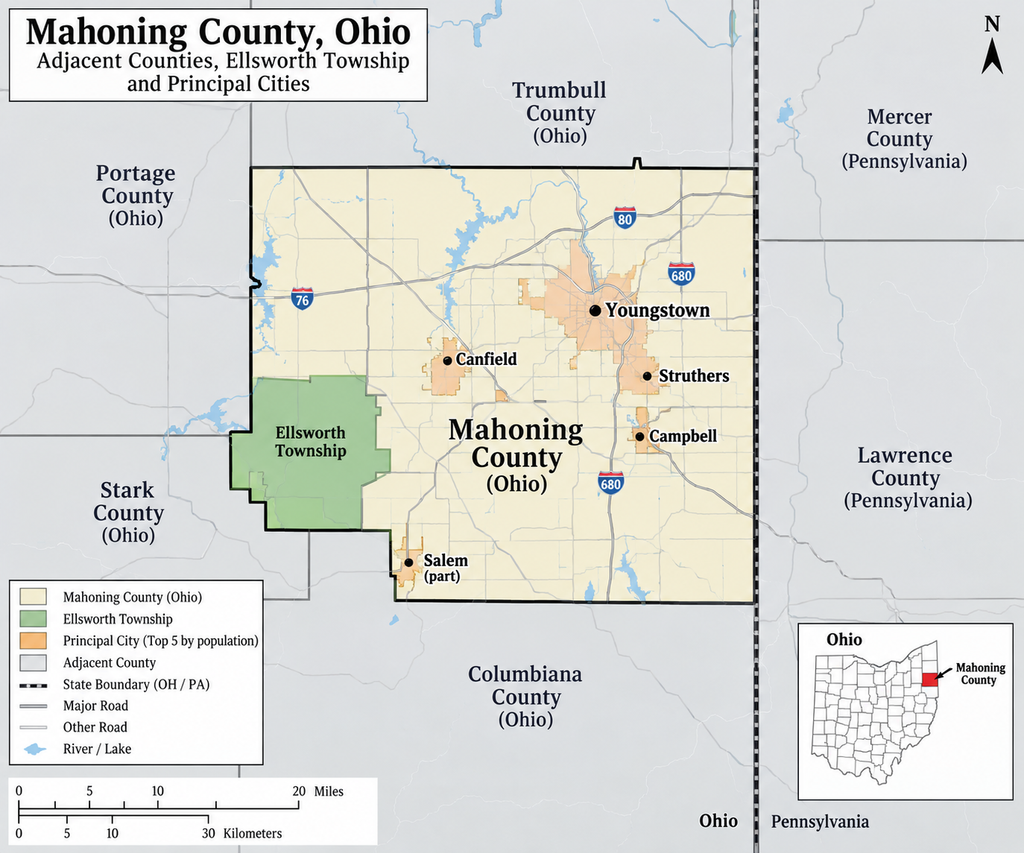
The Northern Tier Utica Shale rock, 6,000 to 7,000 ft deep, is gaining attention for its oil production. especially with oil likely in an extended price premium situation for months to come. Natural gas is most prolific and sought after in wells in the Southeast part of the state, where Utica Shale depths range from 8,000 to 10,000 ft plus. Maximum burial depth controls temperature through the geothermal gradient and cumulative time and temperature determine whether a well produces oil, condensate, or dry gas. Depth also controls pressure, which independently determines the drive energy to bring the oil or gas from the formation fractures to the surface; more on that later, its an interesting wrinkle.
Earlier in 2026 I spoke to a landowner in far southern Ashtabula county, Williamsfield township, who received 3K/acre from their parcel way back when BP was actively acquiring acreage.
Southern Ashtabula county is north of Columbiana, Mahoning and Trumbull counties which are now considered Northern Tier Utica by most. Though the thin geographic line between Trumbull and Ashtabula county is “just a line”. The prospects for southern Ashtabula county Utica Shale leasing is not zero and yet to proven or disproven.
The Results That Generated the Northern Tier Buzz
Hi, this is a comment.
To get started with moderating, editing, and deleting comments, please visit the Comments screen in the dashboard.
Commenter avatars come from Gravatar.
WOW,Very wonderful